A scientist in a lab coat and gloves examines a vial near a Beckman Coulter Life Sciences Cytoflex flow cytometry analyzer, with data from algorithm development displayed on a computer screen in a modern laboratory setting.
Key Innovation By fusing optical science with data engineering, we gave a mature instrument platform the analytical flexibility to outpace dedicated software rivals.
Beckman Coulter logo featuring a stylized circular design next to the company name in bold, uppercase letters.

Flow Cytometer Data Analysis

Client

Beckman Coulter Life Sciences

Overview

The CytoFLEX platform from Beckman Coulter Life Sciences is a market-leading flow cytometry platform designed to provide high sensitivity, strong resolution, and flexible configuration options across a wide range of applications. Built to support advanced sample analysis and regulatory workflows, the platform integrates CytExpert acquisition and analysis software and supports features such as multi-color detection and high-throughput processing.

To expand the platform’s analytical capabilities and strengthen its competitive position against third-party software solutions, Beckman Coulter Life Sciences partnered with Triple Ring to develop advanced data analysis algorithms supporting new high-value customer use cases.

Challenge

A key driver of the CytoFLEX platform’s longstanding market success is its sophisticated data analysis software suite, which allows users to predict unknown properties of their test samples. At project initiation, Triple Ring was tasked with designing algorithms to expand the number of high-value customer use cases from two to ten.

Beckman Coulter Life Sciences sought to capture market value held by third-party solutions while maintaining performance, flexibility, and speed of development across multiple technical disciplines.

Solution

Triple Ring applied cross-disciplinary expertise in optics, simulation, and system design to improve performance and manufacturability.

Key technical efforts included:

  • Optimizing optical subsystem design to improve signal sensitivity
  • Developing analytical models to predict system performance across configurations
  • Supporting integration of acquisition and analysis software workflows
  • Refining system architecture to improve manufacturability and yield
Three white and blue laboratory analyzers of varying sizes are arranged in a row on a plain background. The devices have a modern design with a hexagonal dot pattern on the front panels.

Outcome

The expanded analytics capabilities enabled Beckman Coulter Life Sciences to flexibly support multiple high-value customer use cases, strengthening the competitive position of the CytoFLEX platform and enabling future growth.

The collaboration produced valuable intellectual property and enhanced software capabilities that positioned the platform to capture market share previously held by third-party solutions.

Triple Ring Talent

The Story Behind the Collaboration

At Triple Ring, we draw on a deep bench of expertise across diverse disciplines matched to each innovation challenge. For this project, our team blended deep optics knowledge with advanced algorithm development, data science, and software engineering — expanding the CytoFLEX platform’s analytical capabilities from two to ten high-value customer use cases and capturing market share previously held by third-party solutions.

Daniel and Hailey collaborated with many talented colleagues across Triple Ring and Beckman Coulter on this project.

Meet our team
A portrait of Daniel Badali, a smiling man with glasses and a beard against a gray background.

Daniel Badali, PhD

Optics & Applied Physics

Dr. Daniel Badali brings deep expertise in advanced algorithms, optics, and radiation physics. His work bridges software and hardware, enabling complex simulation, imaging, and sterilization technologies that help turn sophisticated concepts into reliable medical solutions.

A portrait of Hailey Gryka, a woman with glasses and long curly hair smiling against a gray background.

Hailey Gryka

Bioinstrumentation & Data Science

Hailey Gryka brings expertise at the intersection of bioinstrumentation and data science. Her work spans device design, data processing, and system validation, helping teams move seamlessly from early concepts to manufacturable, reliable solutions.

An older woman with long gray hair holds a small medical device to her chest, standing against a plain gray background.
Key Innovation By utilizing a computational breakthrough, we turned a pocket-sized device into a tool capable of synthesizing clinical-grade cardiac diagnostics.
White "HeartBeam" logo with a stylized heart and wireless signal icon forming the letter "B" on a light gray background, capturing the spirit of innovative wearable medical device design.

Cable-Free Synthesized ECG

Client

HeartBeam

Overview

HeartBeam collaborated with Triple Ring to develop an innovative telehealth solution designed to transform the detection and monitoring of cardiac conditions. The goal was to create a compact, portable cardiac monitoring device capable of collecting ECG signals in three dimensions and synthesizing them into a clinically meaningful 12-lead ECG.

The resulting platform supports remote cardiac monitoring by enabling physicians to access real-time data outside traditional clinical settings, expanding access to cardiac diagnostics and improving patient care workflows.

Challenge

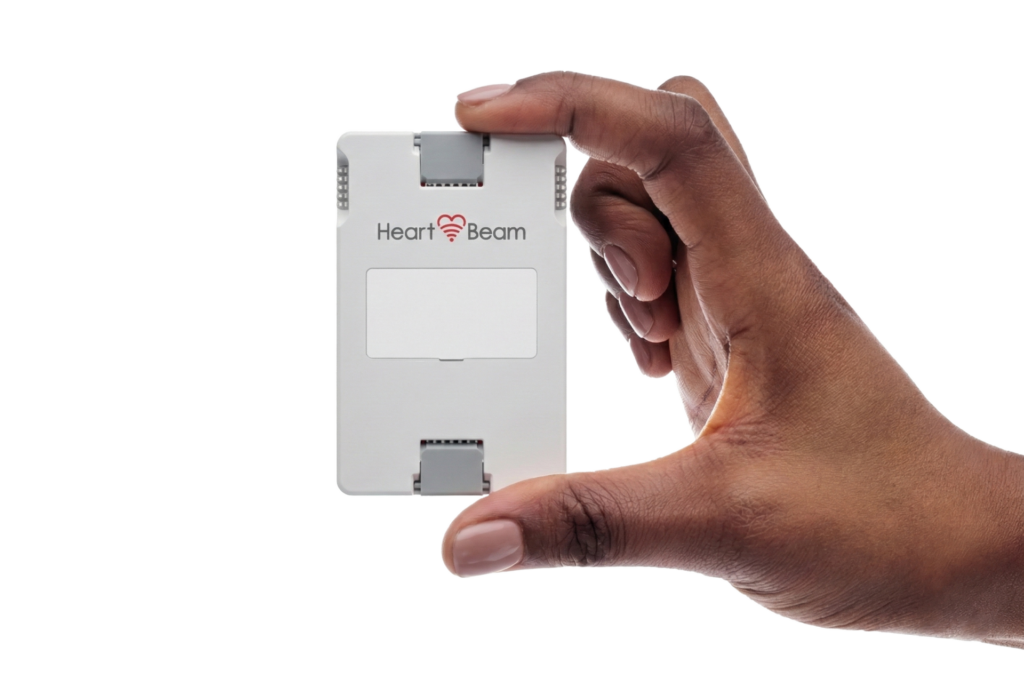
HeartBeam sought to develop a personal, cable-free, and easy-to-use cardiac monitoring solution for both in-clinic and at-home use. The objective was to create a credit card-sized ECG recording device that leverages vectorcardiography (VECG) and integrates with cloud-based software to deliver critical patient data to physicians in real time.

Achieving this required coordinating multidisciplinary device development while meeting regulatory requirements and supporting rapid product development timelines.

Solution

HeartBeam partnered with Triple Ring to execute a comprehensive, five-phase expedited device development program spanning early R&D, industrial design, product development, manufacturing readiness, and regulatory preparation.

Triple Ring applied expertise in wearable medical device design and system integration to develop the cable-free ECG device and supporting ecosystem. The program included device builds for design verification and validation, packaging development, and manufacturing technology transfer to support scalable production.

Key development activities included:

  • Designing compact wearable hardware capable of capturing three-dimensional ECG signals
  • Integrating smartphone-based communication to transmit data securely
  • Developing cloud-connected workflows that enabled remote physician access
  • Supporting regulatory preparation for FDA 510(k) submission and validation
A hand holds a small rectangular medical device labeled "Heart Beam" against a plain white background.

Outcome

The HeartBeam–Triple Ring collaboration produced a personal, cable-free synthesized 12-lead ECG solution that enables patients to record cardiac data at home. The device integrates with a smartphone application that communicates with the HeartBeam Cloud, where synthesized ECG data is compared with baseline records and made available to physicians remotely.

This multidisciplinary and fast-paced program resulted in a successful 510(k) submission to the U.S. Food and Drug Administration (FDA) and regulatory clearance in 2024 for the hardware that leverages vectorcardiography and collects 3D ECG data. The synthesized 12-lead ECG algorithm remains pending FDA clearance.

The completed system enables physicians to remotely monitor cardiac conditions and guide patient care outside traditional healthcare facilities, supporting new models of telehealth-enabled cardiac diagnostics.

Triple Ring Talent

The Story Behind the Innovation

At Triple Ring, we draw on a deep bench of expertise across diverse disciplines matched to each innovation challenge. For this project, our team applied expertise in wearable medical device design, system integration, and regulatory strategy to deliver a cable-free, credit card-sized ECG device — from early R&D through successful FDA 510(k) clearance in 2024.

Walt and Kevin collaborated with many talented colleagues across Triple Ring and HeartBeam on this project.

Meet our team
A portrait of of Walt Cecka, a smiling man with short hair wearing a plaid shirt against a blurred background.

Walt Cecka

Medical Device Design & Translational Medicine

Walt Cecka brings decades of experience translating novel medical technologies into first-to-market products. He works closely with innovators to shape early concepts into structured development programs that advance patient care across a wide range of clinical applications.

A portrait of Kevin Dunk, a smiling man with short brown hair wearing a collared, button-up shirt.

Kevin Dunk

Mechanical & Aerospace Engineering

Kevin Dunk brings expertise in mechanical engineering and multidisciplinary product development across the full device lifecycle. His work supports teams from early prototypes through verification and manufacturing, helping ensure systems are reliable, scalable, and ready for real-world use.

Medical team performing surgery in an operating room equipped with advanced technology.
Key Innovation By coupling high-speed laser-based optical imaging with machine learning workflows, we compressed oncology tissue analysis timelines from days to minutes — directly inside the OR.
Logo with a stylized "B" in blue, red, teal, and yellow, next to the text "BLACKLIGHT SURGICAL" in light letters on a gray background—featured in Triple Ring Technologies' case study on our intra-operative tissue pathology system.

Intra-Operative Tissue Pathology

Client

BlackLight Surgical

Overview

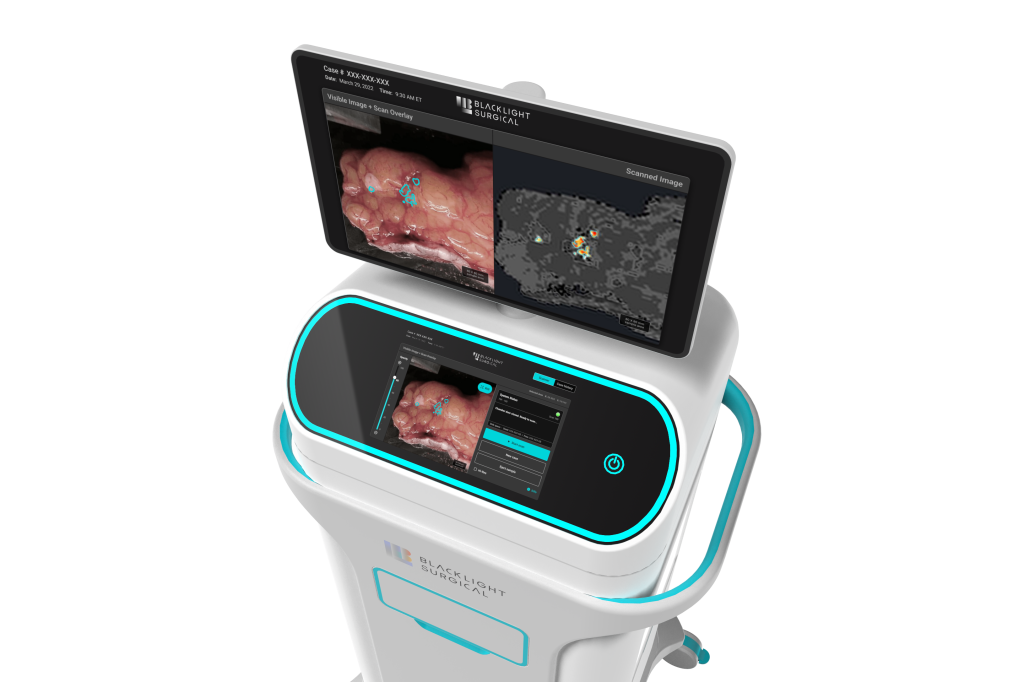
BlackLight Surgical engaged Triple Ring to develop a high-speed biochemical imaging platform designed for intra-operative tissue analysis. The system leveraged picosecond pulsing laser technology and machine learning workflows to enable rapid tissue identification during surgical procedures.

The resulting platform supports real-time clinical decision making by allowing clinicians to distinguish between normal and diseased tissue directly in the operating suite.

Challenge

The system required integration of advanced optical imaging technology capable of performing rapid biochemical analysis during surgery. Reliable performance was required across demanding clinical environments and complex workflows.

Delivering this capability required precise integration of optical, mechanical, software, and machine learning systems into a clinically deployable architecture.

A 3D rendering of BlackLight Surgical's advanced intra-operative tissue pathology medical device cart with dual screens displaying user interface, tissue pathology imagery, and diagnostic data.
Medical professional operating BlackLight Surgical's advanced intra-operative tissue pathology medical device cart with dual screens displaying user interface, tissue pathology imagery, and diagnostic data.
Medical imaging comparison displaying a visible image with scan overlay next to a scanned image highlighting specific areas of interest.

Solution

Triple Ring assembled multidisciplinary engineering and scientific teams to design and integrate the imaging platform using structured development and validation methodologies.

Technical execution focused on:

  • Integrating laser-based optical imaging technologies capable of rapid tissue analysis
  • Developing machine learning workflows that supported real-time tissue classification
  • Using simulation and modeling tools to guide system design and performance optimization
  • Establishing ISO 13485-compliant design and documentation processes

Outcome

Triple Ring delivered a fully integrated intra-operative biochemical imaging platform supporting clinical studies and real-time tissue visualization.

The system was developed to ISO 13485 standards and documented within a Quality Management System transferred to BlackLight Surgical, enabling deployment of advanced intra-operative imaging workflows.

Triple Ring Talent

The Story Behind the Innovation

At Triple Ring, we draw on a deep bench of expertise across diverse disciplines matched to each innovation challenge. For this project, our team combined high-speed laser optical imaging, machine learning, mechanical engineering, and quality systems expertise to develop a fully integrated intra-operative tissue analysis platform capable of distinguishing healthy from diseased tissue in real time.

Todd, Cameran, and Shehadeh collaborated with many talented colleagues across Triple Ring and BlackLight Surgical on this project.

Meet our team
A portrait of Todd Harris, a man with glasses wearing a black shirt against a grey background.

Todd Harris, PhD

Physics & Optical Science

Dr. Todd Harris applies expertise in optics and imaging physics to the development of advanced sensing and illumination technologies. His work combines optical modeling with system design, helping teams translate complex physical principles into dependable, high-performance solutions.

Portrait of Cameran Casale, a person with long, straight brown hair, wearing a white shirt and a necklace, smiling against a blurred background.

Cameran Casale

Bioengineering

Cameran Casale contributes to the development of imaging, microfluidic, and diagnostic technologies across multidisciplinary programs. Her work supports system integration and testing efforts, helping teams refine complex devices for reliable performance in research and clinical environments.

A portrait of Shehadeh Dajani, a smiling man wearing a suit and tie against a blurred background.

Shehadeh Dajani

Aerospace & Mechanical Engineering

Shehadeh Dajani supports the development of safety-critical embedded systems used in regulated medical technologies. His work spans software and system integration across feasibility, clinical, and production stages, helping ensure reliable performance throughout the development lifecycle.

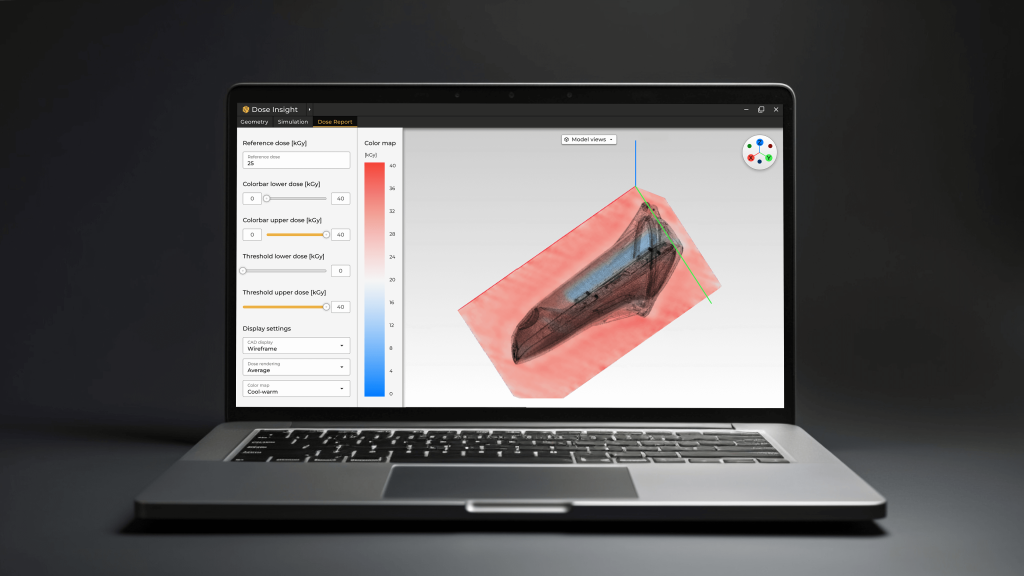
A laptop displaying Dose Insight's Design For Sterilization (DFS) software, a 3d model editing interface with a highlighted dose mapping on the shape.
Key Innovation By translating Monte Carlo radiation physics into an intuitive cloud-based platform, we moved sterilization planning from a late-stage liability to an early-stage design input.
A yellow hexagon logo with white diagonal lines sits next to "Dose Insight" on a light gray background, reflecting Triple Ring Technologies' case study on technical product development for sterilization simulation software design.

Design for Sterilization (DFS)

Client

Dose Insight

Overview

Dose Insight partnered with Triple Ring to develop Design for Sterilization (DFS), a simulation platform designed to support early-stage sterilization planning in medical device development. The system leverages Monte Carlo simulation technology to model radiation dose distribution and guide sterilization strategies before physical prototypes are built.

The platform enables engineers to evaluate sterilization performance directly from CAD models, supporting faster development timelines and reducing reliance on late-stage empirical testing.

Challenge

Medical device sterilization validation is often addressed late in the product development process, after devices have been fully designed and manufactured. When sterilization issues arise at that stage, they can introduce significant costs, delays, and redesign requirements.

The goal was to determine whether advanced computer modeling could enable sterilization strategy development earlier in the design cycle. This required creating accurate Monte Carlo simulation tools that were powerful enough for complex modeling, yet intuitive enough for non-expert users to operate effectively.

A diagram illustrating the Dose Insight workflow for simulating device sterilization, involving a web interface for uploading cad models, cloud-based monte carlo simulations, and reports on dose distribution.
A screenshot of Dose Insight's Design For Sterilization (DFS) software showing the user interface and a 3d model with a highlighted dose mapping on the shape.
A screenshot of Dose Insight's Design For Sterilization (DFS) software showing the sterilization dose report mapped onto a 3d model.

Solution

Triple Ring developed a simulation-driven platform that integrates advanced radiation modeling with user-friendly software workflows. The system enables users to simulate radiation sterilization scenarios directly from digital models, allowing teams to refine designs before committing to costly manufacturing steps.

Development focused on:

  • Applying Monte Carlo simulation techniques to predict radiation dose distribution
  • Designing user-friendly graphical interfaces that enabled early-stage analysis
  • Building scalable cloud infrastructure capable of supporting large computational workloads
  • Validating platform performance across multiple sterilization technologies
A person using Dose Insight software on a laptop.

Outcome

The DFS platform significantly shortened medical device development cycles by enabling sterilization strategies to be implemented early in the design process. The system provides precise radiation dose mapping for complex medical devices, allowing teams to evaluate sterilization performance before physical testing.

By enabling iterative design refinement without extensive prototyping, the platform reduced development costs and minimized the need for expensive late-stage testing. The resulting technology established a validated approach to integrating sterilization planning into early product design workflows.

Triple Ring Talent

The Story Behind the Innovation

At Triple Ring, we draw on a deep bench of expertise across diverse disciplines matched to each innovation challenge. For this project, our team combined Monte Carlo simulation, applied radiation physics, software engineering, and cloud infrastructure expertise to develop a platform that enables medical device teams to validate sterilization strategies directly from CAD models — before a single prototype is built.

Daniel and Tobias collaborated with many talented colleagues across Triple Ring and Dose Insight on this project.

Meet our team
A portrait of Daniel Badali, a smiling man with glasses and a beard against a gray background.

Daniel Badali, PhD

Optics & Applied Physics

Dr. Daniel Badali brings deep expertise in advanced algorithms, optics, and radiation physics. His work bridges software and hardware, enabling complex simulation, imaging, and sterilization technologies that help turn sophisticated concepts into reliable medical solutions.

A portrait of Tobias Funk, a smiling man with grey hair wearing a striped shirt against a blurred background.

Tobias Funk, PhD

Experimental Physics & Instrumentation

Dr. Tobias Funk develops advanced instrumentation that applies ionizing radiation to scientific and medical challenges. His work spans imaging, simulation, and system design, helping translate complex physical principles into practical technologies used in real-world environments.

A female doctor discussing medical records with a patient in a clinic.
Key Innovation By coupling wearable optics with injectable dyes, we enabled continuous, non-invasive kidney monitoring without repeated blood draws or lab visits.
MediBeacon logo with a star graphic above the company name and the tagline "Life, illuminated." in blue text, as featured in Triple Ring Technologies' case study on our technical product development of MediBeacon's transdermal GFR measurement sensor.

Transdermal GFR Measurement

Client

MediBeacon

Overview

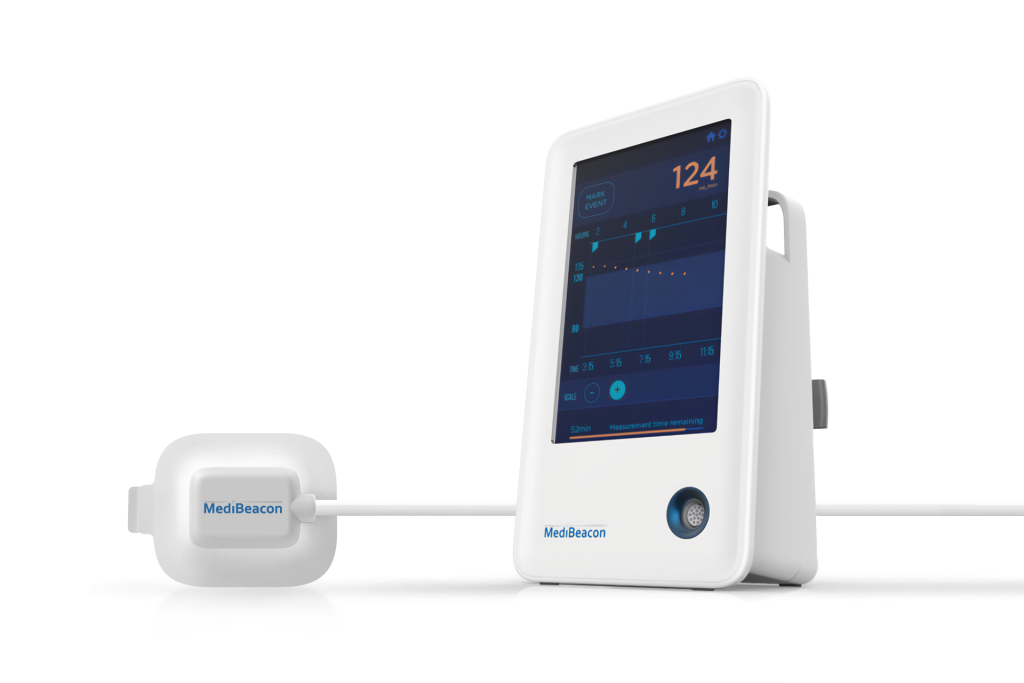
MediBeacon partnered with Triple Ring to develop a photonics-based transdermal detection system designed to measure kidney function using fluorescent tracer technology. The system enables non-invasive monitoring of intravenously injected tracers to generate clinically actionable measurements of glomerular filtration rate (GFR).

The resulting wearable detection platform integrates optical sensing and physiological measurement technologies to support real-time kidney function assessment in clinical environments.

Challenge

MediBeacon required development of a wearable optical detection system capable of monitoring fluorescent tracer signals through human tissue. The system needed to achieve high sensitivity and accuracy while remaining comfortable and practical for clinical use.

In addition to performance requirements, the device needed to meet strict constraints related to cost, usability, and manufacturability. The development effort required careful balancing of optical performance, ergonomic design, and regulatory compliance within a wearable form factor.

A product photograph of MediBeacon's white vital signs monitor and sensor attached to a stainless steel pole against a light gray background.
MediBeacon medical sensor device with branding next to a vial of green liquid.

Solution

Triple Ring collaborated closely with MediBeacon to design and deliver a non-invasive wearable detection system capable of supporting accurate GFR measurement. The development effort leveraged expertise in light-based tissue analysis and system-level modeling to optimize detection performance while supporting user comfort and clinical usability.

The team addressed these challenges by:

  • Applying advanced photonics expertise to optimize signal detection through tissue
  • Using modeling and simulation tools to refine optical system performance
  • Designing wearable hardware that supported patient comfort during extended use
  • Aligning development processes with clinical validation and regulatory expectations
A doctor records data in a notebook at a workstation with the MediBeacon system, sensor, and vial of liquid nearby.

Outcome

Fully integrated wearable GFR detection systems were developed under ISO 13485 design controls and delivered to support critical clinical trials. The resulting devices enabled accurate, non-invasive measurement of kidney function through optical detection of fluorescent tracers.

The platform supported the advancement of MediBeacon’s GFR monitoring technology toward clinical validation, enabling real-time physiological measurement while maintaining patient comfort and usability.

Triple Ring Talent

The Story Behind the Innovation

At Triple Ring, we draw on a deep bench of expertise across diverse disciplines matched to each innovation challenge. For this project, our team combined photonics, transdermal optical sensing, wearable device design, and advanced simulation expertise to develop a clinical-grade wearable system capable of measuring kidney function non-invasively through fluorescent tracer detection.

Gus and Ed collaborated with many talented colleagues across Triple Ring and MediBeacon on this project.

Meet our team
A portrait of Augustus Lowell, a man with glasses and a graying beard wearing a bark turtleneck against a mottled gray background.

Gus Lowell

Systems Architecture & Electrical Engineering

Augustus “Gus” Lowell defines the architecture of complex software and hardware systems across multidisciplinary programs. His work establishes the frameworks that connect data processing, control, and safety-critical functions, helping ensure technologies operate reliably as integrated systems.

A portrait of Ed Solomon, a smiling man with a mustache wearing a striped shirt.

Ed Solomon

Electrical Engineering & Advanced Technologies

Ed Solomon connects advanced engineering with business strategy to help bring innovative technologies into practical use. His work supports system architecture, partnership development, and technology adoption, helping organizations move complex ideas toward successful deployment.

A happy dog wearing One Health Group's Voyce heart monitor with a bandaged leg on a vet examination table while a veterinarian works in the background.
Key Innovation By packaging continuous biometric and wireless monitoring into an animal-ready wearable, we unlocked a new standard of veterinary care.
One Health logo with 'One' in orange and 'Health' in blue, featuring a blue curved line connecting the words, inspired by Triple Ring Technologies' case study on our technical product development of One Health Group's Voyce physiological monitor.

Veterinary Vital Sign Monitor

Client

One Health Group

Overview

One Health Group partnered with Triple Ring to develop a non-invasive wearable physiological monitoring system designed to capture biometric data from animals in real time. The system was developed to support continuous health monitoring in veterinary settings while improving patient comfort and enabling early detection of health issues.

The resulting wearable platform integrates physiological sensing and wireless communication technologies to enable long-term monitoring and provide actionable health insights for veterinary care providers.

Challenge

One Health Group required development of a wearable monitoring device capable of accurately measuring physiological signals in animals while remaining comfortable and suitable for continuous use. The system needed to support long-term data collection and deliver real-time alerts without interfering with normal animal movement.

As a lean startup organization, One Health Group relied on a fully outsourced R&D model. The project required multidisciplinary engineering expertise to design, prototype, and validate a complex sensing platform while rapidly demonstrating feasibility and reducing development risk.

Black pet collar with integrated One Health Group's Voyce physiological monitoring device.
A drawing of a hand assembling the One Health Group's Voyce animal physiological monitor onto a collar.
A digital illustration of One Health Group's Voyce physiological monitor on a dog with a transparent section showing internal anatomy.

Solution

Triple Ring led the development of a wearable physiological monitoring platform using a structured feasibility and product development approach. Industrial design, sensing technologies, and system integration were coordinated to ensure reliable performance and comfort across extended wear conditions.

Key contributions included:

  • Designing wearable hardware capable of supporting continuous physiological monitoring
  • Conducting rapid feasibility testing to validate sensing and alert functionality
  • Refining industrial design to improve comfort, usability, and durability
Black pet collar with integrated One Health Group's Voyce physiological monitoring device.

Outcome

Triple Ring delivered robust functional prototypes capable of generating high-quality physiological data suitable for ongoing product development and validation. The system demonstrated the feasibility of continuous biometric monitoring in veterinary applications.

The successful development effort supported One Health Group’s technology roadmap and strengthened its value proposition, enabling expanded partnerships with strategic investors in the veterinary health industry.

Triple Ring Talent

The Story Behind the Innovation

At Triple Ring, we draw on a deep bench of expertise across diverse disciplines matched to each innovation challenge. For this project, our team combined physiological sensing, wireless systems, industrial design, and startup-focused R&D expertise to develop a wearable continuous monitoring platform capable of capturing real-time biometric data from animals in veterinary settings.

Brian and Steve collaborated with many talented colleagues across Triple Ring and One Health Group on this project.

Meet our team
A portrait of Brian Wilfley, a smiling man with white hair and glasses in a blue shirt against a gray background.

Brian Wilfley, PhD

Experimental Physics & Instrumentation

Dr. Brian Wilfley leads the development of complex measurement and instrumentation systems grounded in experimental physics. His work combines theoretical insight with hands-on experimentation to advance technologies used in imaging, inspection, and scientific analysis.

A portrait of Steven Kuhn, a smiling man with a white mustache and glasses against a gray background.

Steve Kuhn

Embedded Systems & Software Engineering

Steve Kuhn develops embedded software and real-time control systems that support complex hardware-driven technologies. His work focuses on software architecture, motion control, and system simulation, enabling reliable operation across integrated device platforms.

A young girl sitting on the floor reading a book to Kuri the robot companion in a modern living space.
Key Innovation By unifying VCSEL arrays, time-of-flight imaging, and wide field-of-view optics, we delivered navigation and hazard detection that exceeded requirements on an aggressive consumer timeline.
Mayfield Robotics logo with "MAYFIELD" in bold above "ROBOTICS," featured in Triple Ring Technologies' case study on our technical product development of Kuri the robot's vision system, all set on a light background.

Kuri, the Nimble Companion Robot

Client

Mayfield Robotics

Practice Areas

Overview

Mayfield Robotics collaborated with Triple Ring to design and develop an optical guidance system for Kuri, a home companion robot designed to safely navigate and interact within household environments. The system required advanced sensing capabilities to support navigation, hazard detection, and environmental awareness.

The resulting optical platform integrated multiple sensing technologies into a compact architecture capable of supporting simultaneous localization and mapping (SLAM) while meeting strict safety and cost requirements for consumer deployment.

Challenge

Kuri required a sophisticated optical system capable of performing multiple functions, including hazard detection, navigation, and real-time environmental mapping. The system needed to maintain high performance in dynamic home environments while remaining safe for use around humans and pets.

Additionally, the integrated optics needed to meet strict eye-safety certification requirements and support reliable operation under consumer use conditions. Designing this system required combining complex optical components within a compact and manufacturable architecture while meeting aggressive launch timelines.

A front and side view of Kuri, a modern, anthropomorphic robot with a black and white color scheme, accompanied by a charging dock.
Diagram highlighting the different beams used by a Kuri's optical system for navigation and obstacle detection.
An illustration of Kuri's optical sensor's operation, showing the emission and detection of light beams for distance measurement and environmental mapping.

Solution

Triple Ring applied deep expertise in optical system design and robotics integration to develop a navigation system capable of supporting safe and reliable robot operation. The development effort focused on integrating advanced sensing technologies into a scalable and cost-effective architecture.

Engineering efforts included:

  • Designing pulsed vertical cavity surface emitting laser (VCSEL) array systems supporting depth sensing
  • Developing panoramic annular lens configurations enabling wide-area environmental awareness
  • Integrating time-of-flight imaging sensor arrays for real-time distance measurement
  • Engineering optical subsystems compliant with stringent eye-safety requirements
  • Supporting system-level integration and validation to meet cost, performance, and production goals
Optical subassembly of Kuri's robotic visual system, black plastic housing with lenticular clear plastic, PCBa, lens, and other optics.

Outcome

Triple Ring delivered an optical navigation system that exceeded cost and performance requirements while achieving certification for eye safety and compliance with UL 3300 standards. The system enabled reliable navigation and safe operation within home environments.

The completed optical system supported the successful commercial launch of Kuri, with hundreds of units delivered to customers. The design generated multiple patent filings and contributed to Kuri being named Best in Show at CES 2017 by leading technology publications.

Triple Ring Talent

The Story Behind the Innovation

At Triple Ring, we draw on a deep bench of expertise across diverse disciplines matched to each innovation challenge. For this project, our team combined optical system design, VCSEL and time-of-flight sensing, robotics integration, and consumer safety certification expertise to develop a compact, eye-safe optical navigation system capable of supporting simultaneous localization, mapping, and hazard detection in dynamic home environments.

Todd collaborated with many talented colleagues across Triple Ring and Mayfield Robotics on this project.

A portrait of Todd Harris, a man with glasses wearing a black shirt against a grey background.

Todd Harris, PhD

Physics & Optical Science

Dr. Todd Harris applies expertise in optics and imaging physics to the development of advanced sensing and illumination technologies. His work combines optical modeling with system design, helping teams translate complex physical principles into dependable, high-performance solutions.