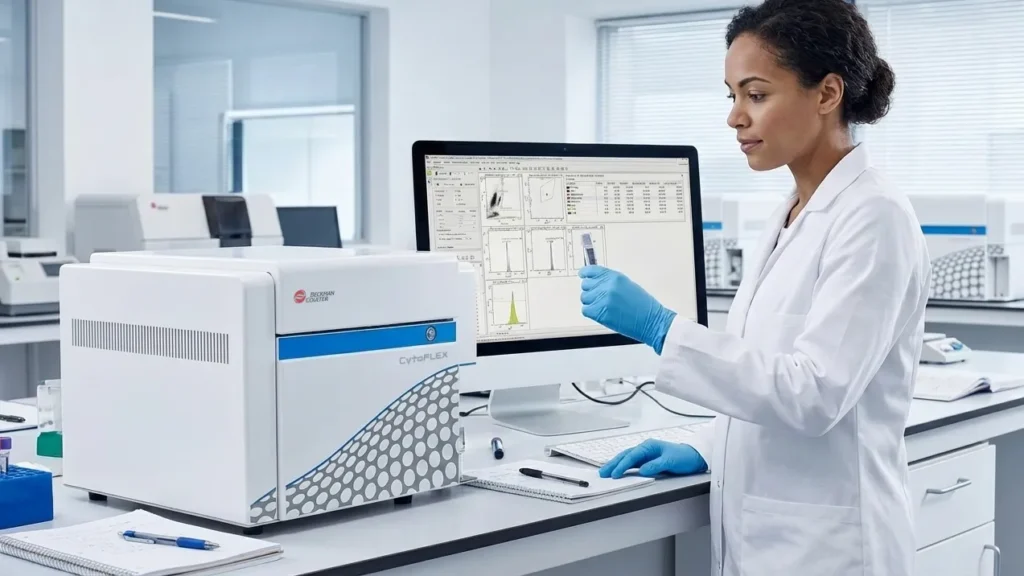
A scientist in a lab coat and gloves examines a vial near a Beckman Coulter Life Sciences Cytoflex flow cytometry analyzer, with data from algorithm development displayed on a computer screen in a modern laboratory setting.
Beckman Coulter logo featuring a stylized circular design next to the company name in bold, uppercase letters.
Key Innovation Advanced algorithms multiplied analytical power fivefold — without new hardware.

Flow Cytometer Data Analysis

Client

Beckman Coulter Life Sciences

Practice Areas

Industrial TechBio & Life Sciences

Core Disciplines

Overview

The CytoFLEX platform from Beckman Coulter Life Sciences is a market-leading flow cytometry platform designed to provide high sensitivity, strong resolution, and flexible configuration options across a wide range of applications. Built to support advanced sample analysis and regulatory workflows, the platform integrates CytExpert acquisition and analysis software and supports features such as multi-color detection and high-throughput processing.

To expand the platform’s analytical capabilities and strengthen its competitive position against third-party software solutions, Beckman Coulter Life Sciences partnered with Triple Ring to develop advanced data analysis algorithms supporting new high-value customer use cases.

Challenge

A key driver of the CytoFLEX platform’s longstanding market success is its sophisticated data analysis software suite, which allows users to predict unknown properties of their test samples. At project initiation, Triple Ring was tasked with designing algorithms to expand the number of high-value customer use cases from two to ten.

Beckman Coulter Life Sciences sought to capture market value held by third-party solutions while maintaining performance, flexibility, and speed of development across multiple technical disciplines.

Solution

Triple Ring applied cross-disciplinary expertise in optics, simulation, and system design to improve performance and manufacturability.

Key technical efforts included:

  • Optimizing optical subsystem design to improve signal sensitivity
  • Developing analytical models to predict system performance across configurations
  • Supporting integration of acquisition and analysis software workflows
  • Refining system architecture to improve manufacturability and yield
Three white and blue laboratory analyzers of varying sizes are arranged in a row on a plain background. The devices have a modern design with a hexagonal dot pattern on the front panels.

Outcome

The expanded analytics capabilities enabled Beckman Coulter Life Sciences to flexibly support multiple high-value customer use cases, strengthening the competitive position of the CytoFLEX platform and enabling future growth.

The collaboration produced valuable intellectual property and enhanced software capabilities that positioned the platform to capture market share previously held by third-party solutions.

Triple Ring Talent

The Story Behind the Collaboration

At Triple Ring, we draw on a deep bench of expertise across diverse disciplines matched to each innovation challenge. For this project, our team blended deep optics knowledge with advanced algorithm development, data science, and software engineering — expanding the CytoFLEX platform’s analytical capabilities from two to ten high-value customer use cases and capturing market share previously held by third-party solutions.

Daniel and Hailey collaborated with many talented colleagues across Triple Ring and Beckman Coulter on this project.

Meet our team
A portrait of Daniel Badali, a smiling man with glasses and a beard against a gray background.

Daniel Badali, PhD

Optics & Applied Physics

Dr. Daniel Badali brings deep expertise in advanced algorithms, optics, and radiation physics. His work bridges software and hardware, enabling complex simulation, imaging, and sterilization technologies that help turn sophisticated concepts into reliable medical solutions.

A portrait of Hailey Gryka, a woman with glasses and long curly hair smiling against a gray background.

Hailey Gryka

Bioinstrumentation & Data Science

Hailey Gryka brings expertise at the intersection of bioinstrumentation and data science. Her work spans device design, data processing, and system validation, helping teams move seamlessly from early concepts to manufacturable, reliable solutions.

A young girl sitting on the floor reading a book to Kuri the robot companion in a modern living space.
Mayfield Robotics logo with "MAYFIELD" in bold above "ROBOTICS," featured in Triple Ring Technologies' case study on our technical product development of Kuri the robot's vision system, all set on a light background.
Key Innovation Three unified optical technologies exceeded navigation targets on a consumer timeline.

Kuri, the Nimble Companion Robot

Client

Mayfield Robotics

Practice Areas

Industrial

Core Disciplines

Overview

Mayfield Robotics collaborated with Triple Ring to design and develop an optical guidance system for Kuri, a home companion robot designed to safely navigate and interact within household environments. The system required advanced sensing capabilities to support navigation, hazard detection, and environmental awareness.

The resulting optical platform integrated multiple sensing technologies into a compact architecture capable of supporting simultaneous localization and mapping (SLAM) while meeting strict safety and cost requirements for consumer deployment.

Challenge

Kuri required a sophisticated optical system capable of performing multiple functions, including hazard detection, navigation, and real-time environmental mapping. The system needed to maintain high performance in dynamic home environments while remaining safe for use around humans and pets.

Additionally, the integrated optics needed to meet strict eye-safety certification requirements and support reliable operation under consumer use conditions. Designing this system required combining complex optical components within a compact and manufacturable architecture while meeting aggressive launch timelines.

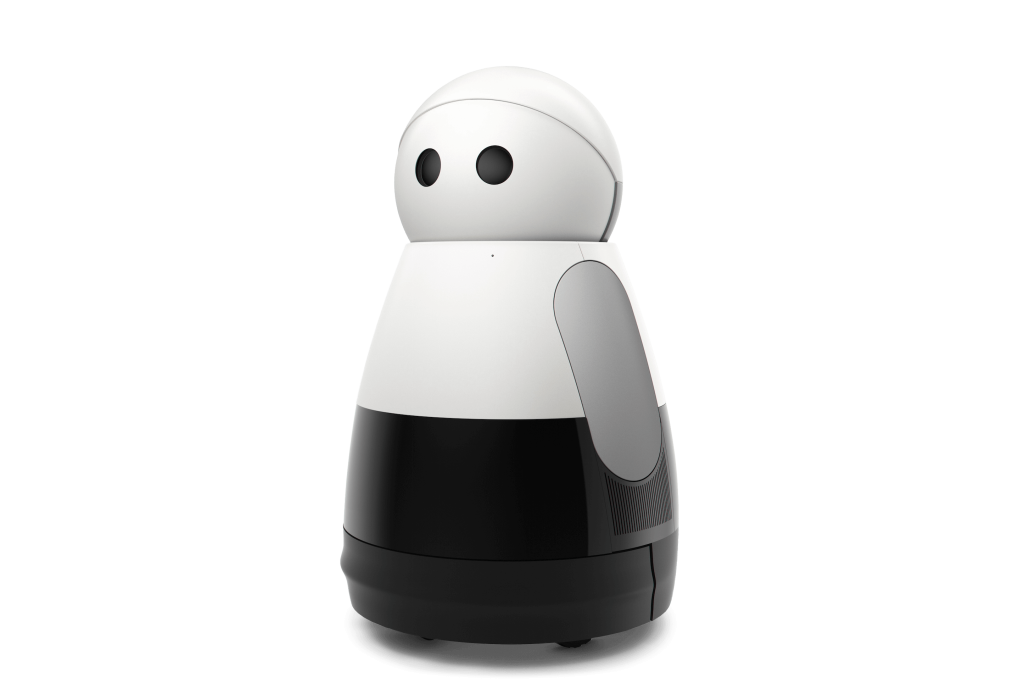
A front and side view of Kuri, a modern, anthropomorphic robot with a black and white color scheme, accompanied by a charging dock.
Diagram highlighting the different beams used by a Kuri's optical system for navigation and obstacle detection.
An illustration of Kuri's optical sensor's operation, showing the emission and detection of light beams for distance measurement and environmental mapping.

Solution

Triple Ring applied deep expertise in optical system design and robotics integration to develop a navigation system capable of supporting safe and reliable robot operation. The development effort focused on integrating advanced sensing technologies into a scalable and cost-effective architecture.

Engineering efforts included:

  • Designing pulsed vertical cavity surface emitting laser (VCSEL) array systems supporting depth sensing
  • Developing panoramic annular lens configurations enabling wide-area environmental awareness
  • Integrating time-of-flight imaging sensor arrays for real-time distance measurement
  • Engineering optical subsystems compliant with stringent eye-safety requirements
  • Supporting system-level integration and validation to meet cost, performance, and production goals
Optical subassembly of Kuri's robotic visual system, black plastic housing with lenticular clear plastic, PCBa, lens, and other optics.

Outcome

Triple Ring delivered an optical navigation system that exceeded cost and performance requirements while achieving certification for eye safety and compliance with UL 3300 standards. The system enabled reliable navigation and safe operation within home environments.

The completed optical system supported the successful commercial launch of Kuri, with hundreds of units delivered to customers. The design generated multiple patent filings and contributed to Kuri being named Best in Show at CES 2017 by leading technology publications.

Triple Ring Talent

The Story Behind the Innovation

At Triple Ring, we draw on a deep bench of expertise across diverse disciplines matched to each innovation challenge. For this project, our team combined optical system design, VCSEL and time-of-flight sensing, robotics integration, and consumer safety certification expertise to develop a compact, eye-safe optical navigation system capable of supporting simultaneous localization, mapping, and hazard detection in dynamic home environments.

Todd collaborated with many talented colleagues across Triple Ring and Mayfield Robotics on this project.

A portrait of Todd Harris, a man with glasses wearing a black shirt against a grey background.

Todd Harris, PhD

Physics & Optical Science

Dr. Todd Harris applies expertise in optics and imaging physics to the development of advanced sensing and illumination technologies. His work combines optical modeling with system design, helping teams translate complex physical principles into dependable, high-performance solutions.